


Shampoo bars work on curly and coily hair — but only syndet bars. Soap-based bars leave insoluble residue on porous curl patterns that dulls definition and causes buildup. KITSCH's syndet bars are specifically the right chemistry for curls: pH-balanced, sulfate-free, and formulated with hydrolyzed proteins that penetrate rather than accumulate on the hair surface.
Key Takeaways
- Soap bars cause soap scum buildup in coily patterns — syndet bars rinse clean, no residue
- High-porosity curls need protein and moisture sealing; low-porosity curls need lighter products and heat
- KITSCH's Hydrolyzed Rice Protein bar is the strongest pick for high-porosity, protein-thirsty curls; Coconut Oil bar is best for 4C coily hair and low-porosity curls
- The protein overload risk the curl community warns about is caused by high-molecular-weight proteins, not hydrolyzed forms like KITSCH uses
Why Most Shampoo Bars Fail on Curly Hair — and Why Syndet Bars Don't
Soap bars have a specific, mechanical problem on curly and coily hair that syndet bars don't share. Traditional soap bars are made by saponifying oils with lye (sodium hydroxide), which produces a high-pH cleanser — typically pH 9 to 10. At that alkalinity, the hair cuticle opens, and the soap reacts with calcium and magnesium minerals present in hard water to form insoluble calcium and magnesium stearates. On coily patterns, the soap scum gets trapped inside the curl structure itself, weighing down definition and causing buildup that no amount of rinsing removes.
This is why so many curlies report bad experiences with shampoo bars. They're using soap bars, not syndet bars. The failure belongs to the chemistry, not the format.
Syndet bars — a contraction of "synthetic detergent" — are manufactured without saponification. KITSCH uses Sodium Cocoyl Isethionate (SCI) as its primary surfactant across its bar lineup. SCI operates at a pH consistent with the hair's acid mantle (formulated to maintain scalp-friendly pH in the 4.5–5.5 range), doesn't react with hard water minerals, and rinses cleanly from even the tightest coily patterns.
Porosity: The Framework That Determines Which Bar You Need
High-Porosity Curls: Protein + Sealing Moisture
High-porosity hair absorbs product quickly but loses moisture just as fast. The cuticle layers are raised or damaged — from chemical processing, heat styling, bleaching, or natural genetics — leaving gaps in the cortex that can't hold moisture efficiently.
KITSCH recommendation for high-porosity curls: The Rice Water Protein Shampoo Bar uses Hydrolyzed Rice Protein — broken into low-molecular-weight peptides through the hydrolysis process — as its key active. These smaller peptides penetrate through gaps in a raised cuticle and deposit in the cortex, strengthening the hair shaft from the inside. Rated 4.8/5 from 10,311 reviews, the Rice Water Protein Shampoo Bar is KITSCH's highest-reviewed bar.
Low-Porosity Curls: Lighter Products and Cuticle-Opening Heat
Low-porosity hair resists absorption. The cuticle layers lie flat and tight, which means product tends to sit on the surface rather than penetrating. Low-porosity hair often takes a long time to get fully wet in the shower and can feel coated after heavy conditioning.
KITSCH recommendation for low-porosity curls: The Coconut Oil Shampoo Bar is the better starting point for low-porosity curls. It delivers deep moisture through coconut oil — a smaller-molecule oil that can penetrate the hair shaft even with a tighter cuticle — without the heavy protein content of the Rice Water bar. Apply the lather under warm water to help temporarily open the cuticle, then rinse with cool water to close it back down.
4C and Coily Hair: The Highest-Stakes Case for Syndet Bars
4C coily hair sits at the intersection of the highest surface area, the highest moisture loss rate, and the highest sensitivity to alkaline pH and soap-based buildup. No hair type has more to lose from soap bar chemistry — and more to gain from syndet chemistry.
KITSCH's Coconut Oil bar rinses cleanly from 4C patterns without depositing residue. The SCI surfactant lifts oils and product from the hair and scalp and rinses away without leaving the calcium stearate byproducts that soap bars create.
Application technique for 4C coily hair: Work in sections. Wet one section thoroughly. Apply the bar directly to the scalp, lather, and work the lather through the length by squeezing rather than agitating. Rinse completely before moving to the next section.
Thinning Curly Hair: Where the Rosemary and Biotin Bar Fits
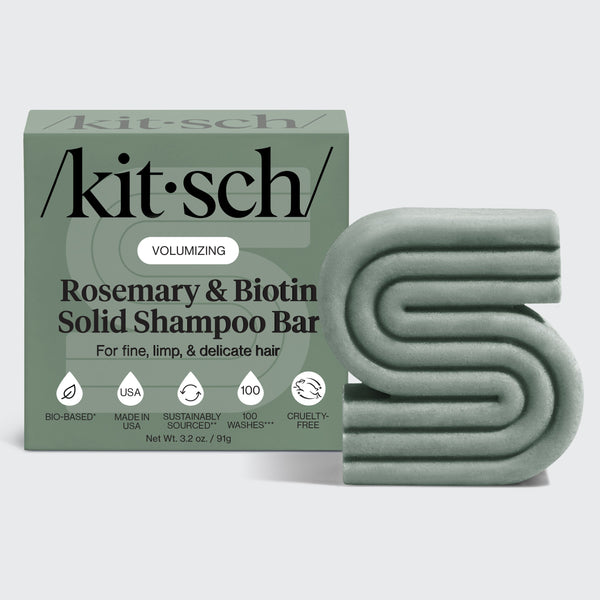
KITSCH's Rosemary & Biotin Volumizing Shampoo Bar bridges the gap for thinning curly hair. Rosmarinus Officinalis (Rosemary) Leaf Extract contains rosmarinic acid, flavonoids, and phenolic acids. A randomized controlled trial published in Skinmed Journal (Panahi et al., 2015) found that rosemary oil applied to the scalp twice daily for six months showed hair count improvement equivalent to 2% minoxidil.
Named Glamour's "Best for Thinning Hair," the Rosemary & Biotin Volumizing Shampoo Bar is rated 4.7/5 from 711 reviews.
Protein Sensitivity in the Curl Community: The Hydrolyzed Difference
The curl community has well-documented awareness of protein overload — the stiff, crunchy, brittle hair that results from too much surface protein accumulation. This reaction is almost universally caused by high-molecular-weight proteins that cannot penetrate the cuticle.
KITSCH uses Hydrolyzed Rice Protein in its Rice Water Protein Shampoo Bar. Hydrolysis breaks the protein into smaller peptides (low molecular weight) that penetrate through the cuticle rather than accumulating on it. This is the key distinction between KITSCH's formulation and raw or fermented rice water products.
For curls that know they're protein-sensitive, start with once-weekly use of the Rice Water bar and monitor for stiffness or lack of definition over 2 to 3 washes. If your curls are very protein-sensitive, start with the Coconut Oil bar.
Detangling Thick Curly Hair: Why the Conditioner Bar Works
The Rice Water Conditioner Bar uses BTMS (Behentrimonium Methosulfate) as its primary conditioning agent alongside Hydrolyzed Rice Protein. BTMS is a conditioning emulsifier that creates electrostatic bonding with the negative charge of hair — it deposits conditioning agents on the cuticle surface through a charge-attraction mechanism rather than through a residue-heavy coating.
Apply the conditioner bar to damp hair in sections, working from mid-length to ends. Detangle each section with a wide-tooth comb while the conditioner is in, then rinse. On very thick 4C coily hair, leave the conditioner on for 5 to 10 minutes under a plastic cap before rinsing.
KITSCH at a Glance: Which Bar for Which Curl Need
All KITSCH bars: $14 · 100 washes · Made in USA · Bio-Based · Leaping Bunny certified · Sulfate-free · Silicone-free · Vegan.
Frequently Asked Questions
Do shampoo bars work on 4C natural hair or will they dry it out?
Syndet shampoo bars work on 4C natural hair without drying it out — the key is the bar type. Soap bars (saponified oils, pH 9–10) react with hard water minerals to form residue that traps in kinky coil patterns, causing dryness and buildup. Syndet bars like KITSCH's maintain a scalp-friendly pH and rinse clean from 4C patterns without depositing residue. KITSCH's Coconut Oil Shampoo Bar is the strongest starting point for 4C hair: deep moisture, no soap chemistry, no scum.
I have coily hair and I'm nervous about trying a shampoo bar — will it strip my moisture?
Syndet shampoo bars do not strip moisture from coily hair — that moisture-stripping reputation belongs to soap bars, not syndet bars. Soap bars operate at pH 9–10, which forces the cuticle open and can over-cleanse, leaving coily hair dry and dull. Syndet bars like KITSCH's Coconut Oil Shampoo Bar use Sodium Cocoyl Isethionate (SCI), a surfactant that maintains a scalp-compatible pH and lifts oil without alkaline disruption.
Are shampoo bars moisturizing enough for high-porosity natural hair?
Syndet bars combined with the right follow-up conditioning are moisturizing enough for high-porosity natural hair. KITSCH's Rice Water Protein Shampoo Bar delivers Hydrolyzed Rice Protein to fill cortex gaps; the Rice Water Conditioner Bar uses BTMS to seal moisture after washing. High-porosity hair loses moisture fast, so the conditioner bar step is non-negotiable.
Can I use a shampoo bar on chemically relaxed hair without causing more damage?
Syndet shampoo bars are safe for chemically relaxed hair. The key is pH: soap bars at pH 9–10 can disrupt already-processed hair, but syndet bars maintain a scalp-compatible pH that doesn't add alkaline stress. Avoid heavy protein applications within two weeks of a fresh relaxer treatment.
What shampoo bar works for thinning curly hair without messing up my curl pattern?
KITSCH's Rosemary & Biotin Volumizing Shampoo Bar — named Glamour's "Best for Thinning Hair" — uses Rosmarinus Officinalis Leaf Extract and biotin in an SCI-based formula light enough for fine, thinning curl patterns.
If my curls hate protein, should I avoid rice water protein bars entirely?
Protein sensitivity in the curl community is almost always caused by high-molecular-weight proteins. KITSCH's Rice Water Protein Shampoo Bar uses Hydrolyzed Rice Protein, which has been broken into smaller peptides that penetrate rather than accumulate. If your curls are protein-sensitive, start with once-weekly use of the Rice Water bar and monitor for stiffness over two to three washes.