


Rosemary leaf extract has peer-reviewed evidence supporting its role in scalp health — but the form of rosemary in your shampoo, and what you're treating, determines whether it will actually work for you. A landmark 2015 randomized controlled trial by Panahi et al. (Skinmed Journal) demonstrated that topical rosemary oil performed equivalently to 2% minoxidil for androgenetic hair thinning over a six-month period. That's a real finding, not a TikTok myth. But the mechanism, the form of rosemary, and the type of shedding you're dealing with all matter enormously — and no one is talking about the distinctions.
Key Takeaways
- Rosemary's active compound, carnosic acid, inhibits 5α-reductase, reducing the DHT that drives androgenetic (pattern) hair thinning
- Panahi et al. (2015, Skinmed Journal) found rosemary oil statistically equivalent to 2% minoxidil for androgenetic thinning — with fewer side effects
- Rosemary fragrance is inert; rosemary leaf extract contains the active phytochemical family; rosemary essential oil has the highest concentration
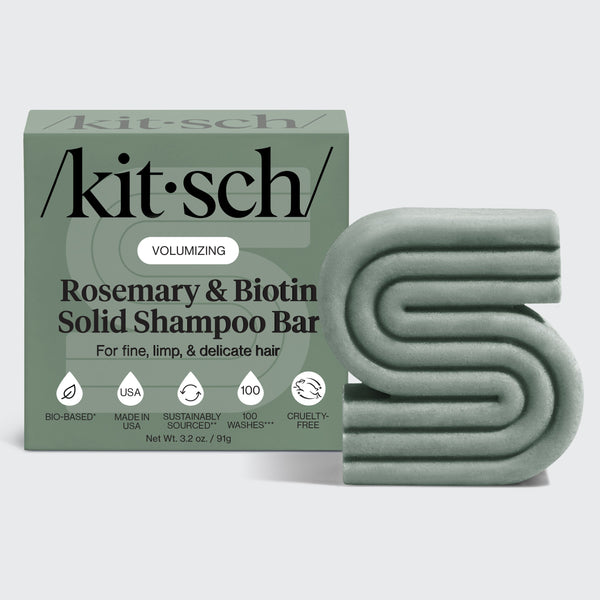
- KITSCH's Rosemary & Biotin bar uses Rosmarinus Officinalis Leaf Extract (not fragrance) alongside surface-strengthening biotin — the active phytochemical family, confirmed on label
What Rosemary Actually Does at the Scalp
Rosemary's active compounds — carnosic acid and rosmarinic acid — inhibit 5α-reductase, the enzyme that converts testosterone into DHT (dihydrotestosterone). DHT drives androgenetic alopecia, the most common form of hair thinning in adults. By reducing DHT at the follicle level, rosemary supports the follicular environment and is associated with reduced androgenetic shedding over time.
The honest framing: rosemary supports the follicular environment by reducing the biochemical conditions associated with androgenetic shedding. That is not the same as regrowing hair, which is an FDA drug claim. What rosemary can do is reduce the rate at which hair thins over time — and there's a peer-reviewed study directly testing that claim.
The Evidence: Panahi 2015 and the Research Behind the Claim
The strongest evidence for rosemary and hair comes from Panahi et al. (2015, Skinmed Journal) — a randomized controlled trial finding rosemary oil statistically equivalent to 2% minoxidil for androgenetic alopecia after six months, with fewer side effects.
The most cited study in the rosemary-for-hair conversation is Panahi et al. (2015), published in Skinmed Journal. In this randomized controlled trial, participants with androgenetic alopecia applied rosemary oil to the scalp twice daily for six months. The control group used 2% minoxidil. At the six-month mark, both groups showed statistically equivalent improvement in hair count. Critically, the rosemary group experienced significantly less scalp itching than the minoxidil group.
What the study does not say: that rosemary is a replacement for minoxidil. The Panahi 2015 finding represents one study on one mechanism for one type of hair thinning. For androgenetic alopecia specifically, the evidence is genuinely promising. For telogen effluvium — diffuse shedding from stress, illness, or postpartum hormonal shifts — rosemary's evidence base is thinner.
One additional important note: the Panahi study used rosemary essential oil. KITSCH's Rosemary & Biotin bar uses rosemary leaf extract. These are not identical. Rosemary leaf extract contains the same active phytochemical family — rosmarinic acid, flavonoids, and phenolic diterpenes — studied in scalp health research. The honest claim: KITSCH uses an ingredient from the same compound family with documented scalp-active phytochemicals.
Rosemary Form Hierarchy: Fragrance vs. Extract vs. Oil
Rosemary fragrance is inert for scalp purposes — aromatic only. Rosemary leaf extract contains the active phytochemical family (carnosic acid, rosmarinic acid, flavonoids) in meaningful concentration. Rosemary essential oil has the highest carnosic acid content. KITSCH's Rosemary & Biotin bar uses Rosmarinus Officinalis Leaf Extract — not fragrance — confirming the scalp-active compounds are present.
KITSCH's Rosemary & Biotin Volumizing Shampoo Bar uses Rosmarinus Officinalis (Rosemary) Leaf Extract — confirmed on the product label. Not fragrance. Not water. The scalp-active phytochemical family is present in the formula. That matters. Many rosemary-branded shampoos list "fragrance" and stop there. KITSCH's formula lists the actual extract.
The Biotin Question: Topical vs. Oral, Realistic Expectations
Topical biotin in shampoo does not penetrate to the follicle in meaningful amounts — it works at the hair shaft surface level, supporting keratin structure you can see and feel. Oral biotin is better studied for follicular effects, particularly in people with biotin deficiency. In a shampoo formula, biotin functions as a surface-active strand-strengthening ingredient, not a follicle stimulator.
The honest read: in KITSCH's Rosemary & Biotin Volumizing Shampoo Bar, biotin functions as a surface-active strengthening ingredient alongside rosemary's scalp benefits. These are distinct, complementary mechanisms — rosemary working at the scalp level to support the follicular environment against DHT, and biotin working at the strand level to support hair shaft integrity.
KITSCH's Rosemary & Biotin bar also contains NaturePep® Amaranth (Amaranthus Caudatus Seed Extract), a natural peptide that enhances hair's structural integrity by increasing the diameter of individual hair fibers and reducing friction between strands.
Is the TikTok Claim True? The Minoxidil Question
One study (Panahi 2015) found rosemary oil equivalent — not better — to 2% minoxidil for androgenetic thinning over six months. Minoxidil has decades of clinical trials and FDA approval; rosemary has one well-designed RCT. "Equivalent in one study" is a meaningful finding. It is not a claim that rosemary outperforms minoxidil, and it does not apply to all types of hair loss.
One practical observation: minoxidil requires twice-daily application on a continuous basis and discontinuing it can lead to accelerated shedding. A rosemary shampoo is a low-commitment, zero-side-effect entry point to the 5α-reductase inhibition pathway. For mild to moderate androgenetic thinning in its early stages, it represents a genuinely rational first step.
Who Should Use Rosemary and Biotin for Hair
Rosemary extract is best suited for people dealing with androgenetic alopecia — gradual, diffuse thinning typically at the crown and hairline, driven by DHT sensitivity at the follicle. For people who want a scalp-active shampoo that supports the follicular environment without prescription drugs, rosemary extract is a reasonable, evidence-informed choice.
KITSCH Rosemary & Biotin Volumizing Shampoo Bar
Named Glamour's "Best for Thinning Hair," KITSCH's Rosemary & Biotin bar is the only shampoo bar to receive a Condé Nast editorial designation for this specific concern. The formula's rosemary ingredient is confirmed as Rosmarinus Officinalis (Rosemary) Leaf Extract — not fragrance, not water.
At $14 for 100 washes, this is the active ingredient stack of specialty growth shampoos at drugstore pricing. The KITSCH Rosemary & Biotin Volumizing Shampoo Bar delivers rosemary leaf extract — the same phytochemical family studied in peer-reviewed scalp research — alongside biotin and Amaranthus peptides for the price of a movie ticket.
Product specs: $14.00 · 3.2 oz / 91g · 100 washes · Bio-Based · Made in USA · Sulfate-free · Paraben-free · Silicone-free · Vegan · Cruelty-Free (Leaping Bunny) · 4.7 stars across 711 reviews